
With the publication of the final specifications for KerML v1.0, SysML v2.0 and the Systems Modelling API v1.0, the Object Management Group (OMG) has kicked off a new era in MBSE.
With the official SysMLv2 specifications, the official reference documents for the next generation of model-based systems engineering (MBSE) are now available. LieberLieber has also been working on this topic for some time; not least, the new standards are being incorporated into the product development for LemonTree 5.0, which is scheduled for release at the end of June 2026.
The new standards form the basis for modernised, consistent and interoperable modelling – from a precise foundation (KerML), through the Systems Modeling Language (SysMLv2), to the technical interface (Systems Modeling API). This move was prompted by the limitations of UML, which is a modelling language for (object-oriented) software systems. Furthermore, SysMLv1 contained inconsistencies in semantics and offered few opportunities for reusing models or for automation. In addition, an API was specified that allows data from a SysMLv2 model to be queried in a structured manner. .json was adopted as the new exchange format, which is now finally leading to standardisation and significantly facilitating the exchange of data between previously incompatible modelling systems.
Language concepts
SysMLv2 enables the following system concepts to be modelled:
- Structure
- Behaviour
- Requirements
- Interfaces
- Parametrics
- Variability
The new language also includes textual notation.
LemonTree – Support for SysMLv2
LemonTree is already established globally as a commercial diff and merge tool, though primarily for Enterprise Architect UML / SysMLv1 models. For SysMLv2, LemonTree supports the textual notation (.sysml) and the official exchange format (.json) based on the new standard. Consequently, it supports all modeling tools that also implement the new SysMLv2 standard and therefore offer these formats.
Dr. Konrad Wieland, Managing Director of LieberLieber, comments: “We welcome the introduction of SysMLv2, which enables us to exchange data with many other tools on the modeling market. However, we would like to emphasize that while SysMLv2 models can be processed with purely textual diff and merge tools, only LemonTree ensures that the result is consistent and valid.”
LemonTree reads the entire model content and interprets the complete dependency graph. This allows the effects of changes to be displayed in a comprehensible manner. This is particularly necessary when a complex scenario is defined in a SysMLv2 model and a change to a definition (part defs) affects many of the derived instances (parts). Philipp Kalenda, Head of Consulting at LieberLieber: “Even if the model is edited in parallel via a view and the text editor, the merge in LemonTree always takes place via the underlying model and not via a textual merge.”
The following features are planned for the first preview version of LemonTree 5.0 at the end of June 2026:
- Diff and merge of textual notation (.sysml files)
- Diff and merge of the SysMLv2 exchange format (.json)
- Migration from .sysml to .json and vice versa
- In LemonTree, it will be possible to use impacted elements, the model tree, and textual notation for diff analysis. A graphical notation display is already in development.

Dr. Konrad Wieland
CEO of LieberLieber
Textual notation vs. graphical notation
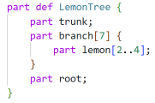
With textual notation, SysMLv2 offers a new way to create, edit and visualise models:
However, textual notation does not replace graphical notation:
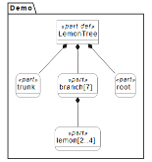
Both notations are equivalent and represent the underlying SysMLv2 model. Tool providers adopt different strategies for SysMLv2 and focus on different editing methods.
Vendors are pursuing various strategies for SysML v2
Here is a selection of vendors and open-source tools that follow a ‘textual-first strategy’ (vendor – tool):
- Sensmetry – SysIDE
- SysGit – SysGit
- OMG – SysML v2 Pilot Implementation
In comparison, here is a selection of vendors/open source tools that follow a “graphical-first strategy” or where (simultaneous) editing of both notations is planned for the future:
- Sparx Systems – Enterprise Architect Trechoro
- Dassault Systèmes – CATIA Magic / Cameo SysML v2
- Siemens – Systems Modeler
- IBM – Rhapsody Systems Engineering
- Ansys (Synopsys) – System Architecture Modeler
- Eclipse Foundation – Eclipse SysON
Both types of tools also offer the option to visualise both notations, either directly within the tool or via export or the generation of views.
Advantages of textual notation
Textual notation is a new approach to modelling designed to make it easier to involve people from the traditional software development sector in the modelling process. Furthermore, textual editing enables the following use cases:
- Generative AI
- Bulk editing (Trace and Replace)
- IntelliSense and syntax validation
Advantages of graphical notation
Graphical notation builds on the original concept of ‘visual modelling’ to represent complex issues graphically. This makes it easier to involve stakeholders from outside the technical domain. As graphical notation is more intuitive to read, the model can be used more easily as a general source of information.
Combining both notations
SysMLv2 allows for a flexible approach in which both notations are used simultaneously, combining their respective strengths. Regardless of the chosen notation, the elements, relations and views are stored in the model repository as structured, graph-based information. The model repository thus provides the basis for collaboration, data exchange, and the evaluation and automation of the model.
Version control and SysMLv2
SysMLv2, with its textual notation and .sysml files, enables version control of SysMLv2 models using version control systems such as Git. However, only one view (the textual view) of the model is placed under version control and taken into account during comparison, merging and conflict resolution. Although the textual notation can be interpreted and compared on a line-by-line basis, references, dependencies and cross-references are not taken into account. Despite the similarity of the textual notation to conventional source code, a SysMLv2 model is not equivalent to it. Therefore, for collaboration using version control, a special diff and merge tool (LemonTree) is required that interprets model data as such and displays it in its graph structure.
LieberLieber in OMG’s SysMLv2 Tool Vendor List: https://www.omg.org/sysml/sysmlv2/sysml-tool/
Infobox
SysMLv2: Model/Text/Graphical Representation
At present, there is a strong focus within the community on the textual notation of SysMLv2 models. However, this is equivalent to the graphical notation, which is comparable to the diagrams in SysMLv1. The focus at LemonTree is on the model-based view (graph = tree-like view), which is generated from the underlying model. This means that the comparison of models is calculated from the SysMLv2 model rather than the textual notation.
Infobox
FAQs about LemonTree SysMLv2
Do I need to switch to SysMLv2 straight away to use LemonTree?
No, LemonTree still supports UML / SysMLv1 models.
Can I use SysMLv2 in combination with Git and LemonTree?
LemonTree offers a 3-way diff and merge and can be integrated into common version control systems. During a diff and merge, LemonTree can be launched from the Git client and the SysML(v2) model passed over. Upon merging, the resulting model is written back to Git.
How can conflicts be resolved?
Where possible, LemonTree performs an automatic merge of models. If changes overlap (e.g. the value of the ‘Mass’ attribute changes in two branches), LemonTree displays this conflict. Using the merge preview, the conflict can be edited and a decision made as to which value should be included in the merge result.
Can I use conventional software development processes?
As LemonTree functions purely as a diff and merge tool, it can be combined with any Git process. For example, it can be used with GitFlow and pull requests in GitHub.
Which modelling tools does LemonTree support?
LemonTree is already established globally as a commercial diff and merge tool, although primarily for Enterprise Architect UML / SysMLv1 models. For SysMLv2, LemonTree supports the textual notation (.sysml) and the official exchange format (.json) based on the new standard. Consequently, all modelling tools that also support the new SysMLv2 standard and therefore offer these formats are supported.